
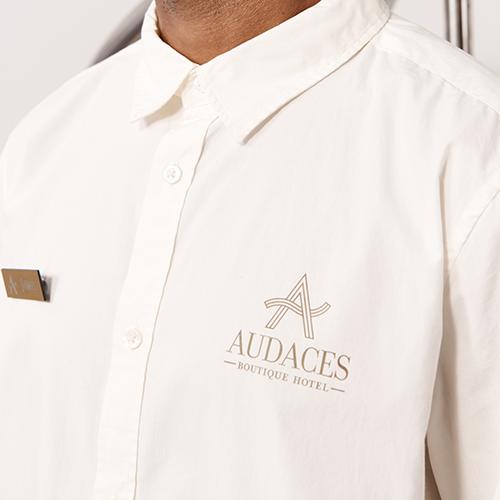
Every time an employee walks into a client meeting, stands behind a trade show counter, or delivers a package wearing your logo, your brand is doing marketing for you. Branded workwear is one of the most cost-effective visibility tools a business can invest in - but it works only when the print quality holds up after dozens of washes and the garments are comfortable enough to actually be worn.
This guide walks you through everything you need to know before placing a custom workwear order. How to choose the right garments? How to picking the right printing technique? What about preparing the artwork? We are covering all of the most important questions that you may ask.
Why Branded Workwear Matters
Research consistently shows that customers perceive uniformed staff as more competent and trustworthy. For service businesses - hospitality, logistics, construction, retail - branded workwear signals reliability even before a word is spoken.
Beyond customer perception, such workwear also reinforces team identity internally. Staff who wear a shared uniform tend to feel a stronger sense of belonging and are more likely to represent the company positively outside working hours.
Step 1: Choose the Right Garments
Not all workwear is the same. Before thinking about print techniques or logo placement, decide what your team actually needs to wear - and what conditions they work in.
T-shirts and Polo shirts are the choice for a classic workwear garment set. Look for cotton or cotton-polyester blends (but mostly cotton) that hold shape after repeated washing. A 180-220 g/m2 weight strikes the right balance between durability and comfort.
Sweatshirts and hoodies suit teams working outdoors or in cooler environments. Heavyweight fleece-lined options (300 g/m2+) offer genuine warmth; lighter French-terry constructions work year-round.
Softshell and technical jackets are essential for field delivery drivers and construction staff. These need durable, weather-resistant fabric - and the printing technique must cope with synthetic materials.
Caps and bags extend your branding beyond clothing and are popular additions to a complete branded uniform package.
Step 2: Pick the Right Printing Technique
The fabric composition of your chosen garment largely determines which printing method makes most sense. If you're not sure about what technique to choose, we're happy to help. Below you'll find a short description of the most popular techniques.
Screen printing is the classic choice for T-shirts and sweatshirts in medium-to-large quantities. It delivers extremely durable, vibrant colours and is cost-efficient from around 25 pieces per design. If your logo uses 1-4 spot colours and you are ordering the same design repeatedly, screen printing almost always offers the best price per unit over time. Print Union specialises in water-based screen printing, which produces prints that are softer, more breathable, and environmentally friendlier than traditional plastisol alternatives.
DTF (Direct to Film) transfer printing is ideal for polyester jackets, technical wear, and mixed-fabric garments where screen printing is not practical. It handles full-colour designs and fine detail equally well, and works on virtually any surface - including caps and bags.
Embroidery carries a premium feel that printing cannot fully replicate. For corporate polo shirts, uniform jackets, and caps presented to clients or management, embroidered logos signal quality and longevity. It is particularly popular in hospitality and financial services.
Step 3: Prepare Your Artwork
The most common source of delays in workwear orders is artwork that is not print-ready. Following these guidelines will save time and ensure your logo looks exactly as intended:
Provide vector files (.ai, .eps, or high-resolution .pdf). Raster images (.jpg, .png) can work for DTG and DTF but must be at least 300 dpi at the intended print size.
Specify Pantone (PMS) colour references for screen printing. RGB and hex codes describe screen colours, not ink colours - a professional printer will match to PMS.
Check your minimum line width. Fine lines below 0.5 mm can be difficult to reproduce cleanly in screen printing, especially on dark garments. DTF handles finer detail more reliably.
Agree on placement and size upfront. Standard chest logo placement is 8-10 cm wide centred left chest. Full-back prints typically run 30-35 cm wide. Ask for a digital mock-up before approving production.
Step 4: Plan for Repeat Orders
Branded workwear is not a one-time purchase. Staff turnover, new hires, and seasonal additions all create ongoing demand. Working with a print partner who stores your project details and makes repeat orders significantly faster and easier.
At Print Union, each client's artwork and technical specifications are stored in the internal archive. Repeat orders use the same graphic files and colour references as the original, providing colour consistency across batches separated by years.
Step 5: Check Ethical and Environmental Standards
Increasingly, businesses face questions from clients and employees about the environmental and ethical footprint of their supply chain. When ordering branded workwear, consider:
Fabric certifications: Look for GOTS (Global Organic Textile Standard) or OEKO-TEX Standard 100 certified garments to confirm the fabric meets chemical safety standards.
Ink type: Water-based inks contain no PVC, phthalates, or heavy metals. They are safer for workers and produce less hazardous waste than solvent-based alternatives.
Supplier ethics: Print Union publishes an ethical codex covering labour standards, environmental commitments, and supplier auditing - ask your print partner for equivalent documentation.
Getting a Quote
To receive an accurate quote for a branded workwear order, have the following ready:
Garment type and brand/model preference (or let us recommend)
Quantity per size and colour
Print positions and design colours
Vector (or 1:1 min. 300 dpi raster) artwork file
Required delivery date
With this information, Print Union can typically provide a full quote within a few hours.
Ready to kit out your team? Contact Print Union for a free consultation and sample request.