
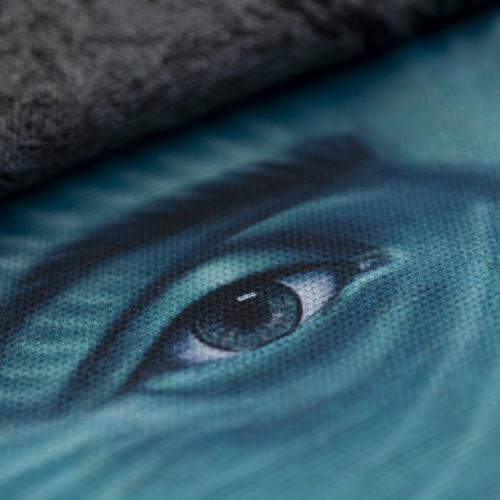
Sublimation is a printing technique that has revolutionized the way we create durable and striking prints. This process involves the use of special sublimation inks that, under high temperature and pressure, transition from a solid state directly into a gaseous state. At that moment the dye penetrates deeply into the material's structure, bonding with its fibers or polymer coating. The result? The print becomes an integral part of the surface — it is not detectable to the touch, does not crack, does not wear off, and does not lose color even after many washes or prolonged use.
Sublimation is particularly popular in the advertising, apparel, and decorative industries because it allows photos, graphics, and patterns to be reproduced with photographic precision and a full color palette.
On which materials can we use this technique?
Sublimation printing works well on surfaces made of polyester or on materials coated with a special polymer layer that allows the dye to penetrate. That is why sublimation is so often used for producing:
Sports and promotional clothing – t-shirts, hoodies, leggings, caps, bandanas, or bags made from polyester fabrics.
Promotional items – mugs, bottles, mouse pads, keyrings, lanyards, phone cases, tags.
Decorative elements – cushion covers, curtains, polyester canvas prints, flags, banners, or posters.
Objects made of hard materials – like ceramics, glass, metal, or wood, but only if they are coated with a polymer layer.
In practice, sublimation offers huge customization possibilities — from single projects to large production runs, while maintaining excellent quality and color reproducibility.
On which materials can’t we use it?
Not every material is suitable for sublimation printing. It works best on light-colored fabrics; on a dark background the print may not turn out as intended. Sublimation does not work on natural fibers such as cotton, linen, silk, or wool because they do not contain polyester and the dye has nothing to bond with. Prints on such fabrics simply will not hold — they will fade after the first wash or wear away completely.
The same applies to surfaces that are not coated with polymer, such as plain metals, glass, ceramics, or wood — without a special coating, sublimation will not work. In such cases it is worth using alternative methods, e.g., screen printing, heat transfer printing, flex/flock vinyl, or laser engraving, depending on the type of material and the desired effect.
Advantages of this technique
Sublimation is a method that combines aesthetics, durability, and versatility.
Print durability – the dye penetrates the material's structure, so the print does not fade, crack, or wear off even after years of use.
High image quality – the technique allows full-color printing with photographic accuracy and smooth tonal transitions.
Resistance to external factors – sublimation prints are resistant to UV radiation, water, sweat, and detergents.
No design limitations – you can print any graphics, photos, texts, and patterns without creating screens as in screen printing, which reduces costs for small runs.
Eco-friendly process – sublimation does not require solvents, glues, or additional chemicals. It's a clean technology, safe for the environment.
Comfort of use – the print is not noticeable on the fabric, so the clothing remains lightweight, breathable, and comfortable.
Sublimation printing is an excellent solution for individuals and companies looking for durable, colorful, and aesthetic prints. It works well in the production of promotional items as well as in the fashion, sports, and decorative industries. There is only one condition — the material must contain polyester or be coated with a special polymer layer. If you care about intense colors, durability, and full customization, sublimation is a technique that will certainly meet your expectations.